



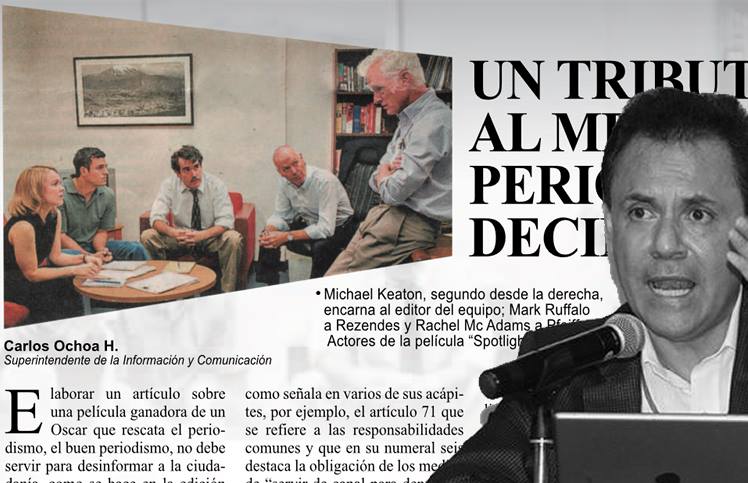
Superintendente impone réplica, molesto por opinión sobre Spotlight que cuestiona a la LOC
El 12 de marzo de 2016, diario El Comercio publicó en media página, una “réplica” del Superintendente de la Información y Comunicación, Carlos Ochoa, por un artículo de opinión escrito por el periodista Arturo Torres, sobre la película ganadora del Oscar “Spotlight.
El periódico publicó la réplica, que llegó a la redacción diagramada y titulada, dejó en claro que el medio se vio obligado a hacerlo, pese a que la Ley de Comunicación establece en su artículo 24, que las réplicas solo caben cuando se aluda directamente a una persona o colectivo, y se afecten sus derechos o reputación. “En este caso no se alude ni al Superintendente, ni a la Supercom”, apuntó el diario.
El periodista, Arturo Torres aseguró en su artículo titulado “Spotlight un tributo al mejor periodismo”, publicado el 6 de marzo, que ese tipo de periodismo investigativo no se podría realizar en el Ecuador porque se correría el riesgo de ser procesado bajo la figura de “linchamiento mediático”, establecida en la Ley Orgánica de Comunicación (LOC).
Ante ello, el titular de la Supercom aseguró en su texto titulado “Un tributo al mejor periodismo es decir la verdad” que Torres “falta a la verdad” y que al contrario de lo que opina el periodista, la Ley motiva a la investigación. “Decir que la Ley de Comunicación impide conocer un caso similar al ocurrido en la arquidiócesis de Boston con los casos de pedofilia, evidencia el total desconocimiento de quien escribe sobre ella”, mencionó el funcionario y concluyó la descalificación al periodista en su texto impuesto a El Comercio que lo dicho por el articulista “carece de todo fundamento”.
Superintendent, annoyed with an opinion about Spolight movie that questions Communications Lay, imposed a reply
On March 12th, 2016, the newspaper El Comercio published in one-half page a “reply” of the Superintendent of Information and Communication, Carlos Ochoa, because of an opinion piece written by the journalist Arturo Torres about the Oscar Best Picture Winner “Spotlight”.
The newspaper published the reply, that was sent to the editorial department and that already had a diagram and a title, making it clear that the media outlet was compelled to do it even when the Organic Law of Communication establishes in Article 24 that “replies” are only possible when a person or a group are directly alluded to, and their rights or reputation are affected. “In this case, neither the Superintendent nor the Superintendence were alluded to”, the newspaper remarked.
In his article titled “Spotlight a tribute for the best journalism”, published on March 6th, the journalist Arturo Torres claimed that that kind of investigative journalism cannot be carried out in Ecuador since one may run the risk of being accused under the legal figure of “media lynching”, established in the Organic Law of Communication (LOC).
Considering that, Supercom’s head stated, in his text titled “A tribute for the best journalism is to tell the truth”, that Mr. Torres “disregards the truth” and contrary to the journalist’s opinion, he added that the Law encourages investigation. “Saying that the Organic Law of Communication prevents from knowing a similar case to the one occurred in the Archdiocese of Boston, regarding the cases of pedophilia, shows the total lack of awareness of the writer”, mentioned the public servant. He concluded discrediting the journalist in his text, which was compelled to be published in El Comercio, by saying that what was said “lacks of foundation”.