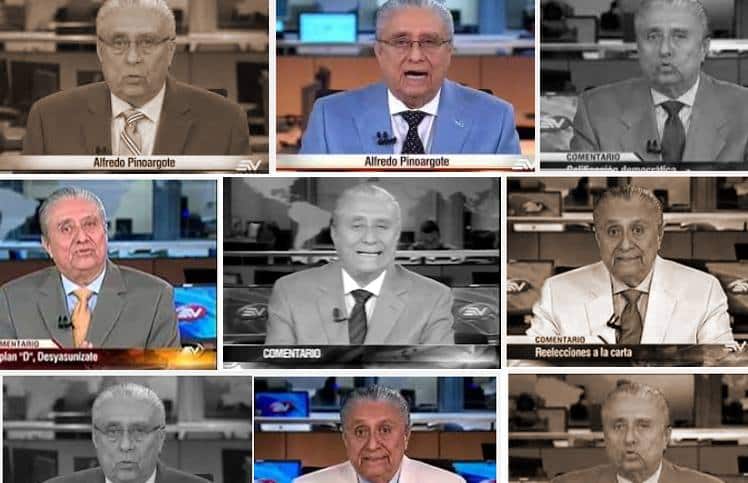
El 8, 9 y 10 de marzo de 2016 tres cadenas ordenadas por la Secretaría Nacional de Comunicación (Secom) interrumpieron a día seguido el programa matutino de entrevistas “En Contacto Directo”, transmitido por la estación televisiva Ecuavisa para descalificar a su conductor, Alfredo Pinoargote, quien cuestionó al gobierno por el dinero que ha gastado en la compra de dos aviones presidenciales, cuando existe una deuda con Solca, una organización que atiende a enfermos de cáncer.
En la primera cadena de tres minutos de duración, el gobierno afirmó que en ese programa no se ha dicho toda la verdad, puesto que Pinoargote, cuando se refirió a que el presidente uruguayo se desplazaba en aviones comerciales, omitió que el gobierno de ese país había comprado un avión para desplazamientos internos del Presidente y sus ministros, un CX-LUR 414 de fabricación estadounidense. Tras esto, la cadena justificó la compra de los aviones presidenciales y desmintió que se traten de un lujo, como había mencionado el presentador de Ecuavisa. “No, señor Pinoargote. Los aviones del Ejecutivo no son un lujo ni son inútiles, son una necesaria herramienta de trabajo..”.
Tras esto, Pinoargote comentó lo siguiente: “Mal de muchos consuelo de tontos, dice la sabiduría popular. Pues se ha viralizado un dispendio a nivel presidencial. En todo caso el presidente del Uruguay solo tiene un avión para desplazamientos internos. La interconexión existe en todas las cabinas de primera clase de las aerolíneas comerciales y con lo que costó el avión alcanza para pagar la mitad de los 120 millones que debe el Gobierno a los pacientes de Solca”.
La segunda cadena difundida al día siguiente interrumpió “En Contacto Directo” durante un minuto y medio para rebatir la respuesta del presentador de Ecuavisa e insistir en que “para todos el avión presidencial es una necesidad, no un mal como lo quiere hacer ver el señor Pinoargote, quien también tuvo que viajar y con seguridad en primera clase mientras se desempeñaba como embajador de la partidocracia”.
Finalmente, la tercera cadena, también de un minuto y medio de duración volvió a responder a Pinoargote y lo acusó de que “a fuerza de repetir una mentira, no se hace la verdad” y que no es consecuente con la ética y el respeto que debe guardar a las audiencias, por haber mencionado sobre la deuda con Solca, pues el gobierno sostiene que esta deuda “fue de 25 millones de dólares de los cuales se pagó ya la mitad y el resto está en proceso de pago”.
Sobre Pinoargote se dijo que “critica los gobiernos neoliberales y de derecha cuando durante años sirvió y se sirvió de ellos” Tras esto, el espacio presentó una lista de los gobiernos en los que Pinoargote fue embajador. “Siempre embajador en Europa como vemos casi en todos los gobiernos de la línea política que ahora aparentemente critica. Y si de embajador a periodista busca oficio no puede basar su ejercicio de información y opinión exclusivamente en una publicación de un sector interesado para anunciar una cifra de la supuesta deuda a Solca sin contrastar o verificar”.
Pinoargote volvió a responder al gobierno y afirmó que “es verdad que a fuerza de decir una mentira no se inventa una verdad y la verdad es que Solca afirma que le deben 130 millones el Ministerio de Salud, el ISSFA, el IESS y el ISPOL. Y de lo que se sabe hasta el momento es de que le han pagado 15. Dónde están los 115 no se sabe, eso le corresponde informar al Gobierno pues, lo demás es irse por las ramas, el meollo del asunto es lo que le deben a Solca. Todo lo demás es para distraer al público televidente y eso sí es falta de ética”, concluyó el presentador.
En lo que va del año se han difundido cinco cadenas en contra de Ecuavisa, las tres últimas en esta misma semana para descalificar a Alfredo Pinoargote, quien es el entrevistador matutino más atacado a través de este mecanismo. Según recogió un informe de Fundamedios, desde 2011, el periodista ha sido descalificado en más de 25 ocasiones. (17 veces a través de cadenas). A lo largo de estos ocho años bajo el gobierno de Rafael Correa, se han utilizado las cadenas como un mecanismo para atacar a la prensa no oficialista y sus invitados, señalados como “opositores”.
Three broadcasts interrupt TV interview program for three days in a row in order to discredit the comments of its presenter
On March 8, 9 and 10, 2016, three broadcasts mandated by the National Communication Secretariat (Secom) interrupted for three days in a row the morning program “En Contacto Directo”, transmitted in the TV station Ecuavisa, for discrediting its presenter, Alfredo Pinoargote, who questioned the government because of the money spent in the acquisition of two presidential aircrafts even when the government is in debt to Solca, an organization for the treatment of cancer.
In the first broadcast of three minutes long, the government affirmed that the complete truth was not told in that program because when Mr. Pinoargote referred to the Uruguayan President and mentioned that he travelled by commercial flights, the presenter omitted that the government from that country had bought an aircraft CX-LUR 414, made in the United States, for travels of the President and the ministers within the country. After this, the broadcast justified the buy of the presidential aircrafts and denied that they are a luxury as the presenter stated. “No, Mr. Pinoargote. The aircrafts of the Executive do not represent a luxury and they are not useless, they are a necessary working tool.”
Then, Pinoargote commented that: “Two in distress make sorrow less, says conventional wisdom, since wastefulness at presidential level has become viral. In any case, the President of Uruguay has just one aircraft for travels within the country. The interconnection exists in all the first-class cabins of the commercial airlines and regarding the price of the aircraft, it is enough to pay half of the 120 million that the government owes to the patients of Solca”.
The second broadcast transmitted the next day interrupted “En Contacto Directo” during a minute and a half in order to refute the answer of the presenter of Ecuavisa and to insist that “for everybody, the presidential aircraft is a need, it is not a harm as Mr. Pinoargote wants to convey, who also had to travel accompanied by security officials in first-class when he worked as ambassador of partyocracy”.
Finally, the third broadcast of a minute and a half long refuted again to Mr. Pinoargote and accused that “by means of the repetition of a lie, the truth cannot be told” and stated that he was not consistent in ethics and respect towards the audience for mentioning the debt to Solca since the government maintains that this debt “was of 25 million from which the half had been already paid and the rest is in payment procedure”.
It was said that Mr. Pinoargote “criticizes neoliberal and right-wing governments even when he worked for them and took advantage of them” After this, the broadcast showed a list of the governments for which he worked as ambassador. “As we can see, he was ambassador in Europe in almost every government from the political line he apparently criticizes now. And if after being ambassador, he became journalist; he cannot base the information and opinion he transmits on a publication of a sector concerned in order to announce a figure of the alleged debt to Solca without verifying or corroborating”.
Mr. Pinoargote replied once again to the government and declared that “it is true that by means of the repetition of a lie, a truth cannot be made up and the truth is that Solca affirmed that the Ministry of Health, ISSFA (Armed Forces Social Security Institution), IESS (Ecuadorian Social Security Institute) and ISPOL (National Police Social Security Institution) owe 130 million to the organization. And what it is known until now is that 15 million were paid. Nobody knows where the remaining 115 million are, and the fact of informing that corresponds to the government, the rest is beating around the bush, the core of the issue is the debt to Solca. Everything else is for distracting the audience and that is lack of ethics.”
So far this year, five broadcasts have been transmitted against Ecuavisa, the last three in this week for discrediting Alfredo Pinoargote, who is the most attacked morning interviewer through this mechanism. According to a report published by Fundamedios, the journalist has been discredited more than 25 times since 2011 (17 of them through mandatory broadcasts). During these eight years under Rafael Correa’s government, the broadcasts have been used as a mechanism to attack the non-pro-government press and its guests, considered as “opposition”.