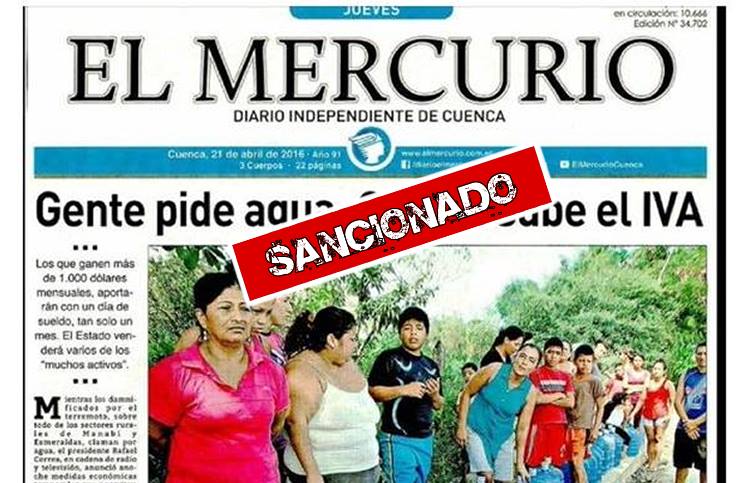
ENGLISH VERSION Diario El Mercurio, de la ciudad de Cuenca fue sancionado el 13 de mayo con una amonestación escrita por parte de la Intendencia de la Información y Comunicación Zonal 6 por considerar que el periódico fue responsable de publicar un titular que no correspondía a la realidad.
La nota titulada: “Gente pide agua; Correa sube el IVA”, referente a los hechos ocurridos tras el terremoto del 16 de abril, salió en portada en la edición del 21 de abril y fue motivo de denuncia de los ciudadanos Alexandra Toledo, Omar Zárate, Marcelo Gómez y Diego Lucero, después de que en redes sociales varios ministros descalificaron al periódico por dicha publicación. Fundamedios pudo constatar que Gómez es funcionario de una dirección distrital del Ministerio de Inclusión Económica y Social MIES. Este dato lo corroboró diario El Mercurio, que afirmó que el funcionario hace constar en su página de Facebook que trabaja en dicho Ministerio, mientras que, según ese diario, Toledo muestra fotografías con altos funcionarios públicos y declara su adhesión al partido de gobierno.
La Intendencia Zonal concluyó que el medio incumplió con el artículo 10, numeral 3 literal a); el numeral 4 literal e); y el artículo 22 de la Ley Orgánica de Comunicación (LOC) referentes a la obligación que tienen los medios de verificar y contrastar la información y “cuidar que los titulares sean coherentes y consistentes con el contenido de las noticias”.
El argumento que dio el abogado de los denunciantes fue que en la segunda parte del titular se hace una aseveración “alejada de la realidad” por considerar que el tema del aumento del IVA no era un hecho consumado, sino una propuesta, mientras que la defensa del medio encabezada por Carlos Castro argumentó que el titular “Gente pide agua...” es el resultado del trabajo de cobertura de sus periodistas en la zona del desastre, y la segunda parte “…Correa sube el IVA” fue una conclusión a la que llegaron luego de las declaraciones del Presidente realizadas a través de una cadena nacional”, afirmó el abogado.
La entidad reguladora dio la razón a los denunciantes por considerar que el medio no verificó que el contenido del titular correspondía a la realidad “más aún cuando en la fuente u orígen de la información se dice con absoluta y meridiana claridad que se trata de una propuesta, lo que no ha ocurrido”, según consta en la resolución.
Tras esto, el Superintendente Carlos Ochoa, en rueda de prensa el 13 de mayo, justificó la sanción contra El Mercurio y negó que exista una “confabulación” para acumular sanciones contra ese medio. En ese sentido aseguró que se trató de una denuncia ciudadana y no de oficio.
First sanction to a media outlet for information related to the earthquake
The newspaper El Mercurio, from Cuenca, was sanctioned on May 13th, 2016, with a written warning by the Intendancy of Communication and Information Zone 6 for considering that the newspaper was responsible of publishing a headline that did not correspond to reality.
The article titled: “People ask for water; Correa raises VAT”, referring to the incidents occurred after the earthquake on May 16th, was published in the front page of the edition of April 21th and that was the reason why the citizens Alexandra Toledo, Omar Zárate, Marcelo Gómez and Diego Lucero presented a complaint after many ministers discredited the publication of that newspaper in social networks. Fundamedios could verify that Mr. Gómez is a civil servant of the district of Ministry of Economic and Social Inclusion (MIES) in that city. This information was corroborated by the newspaper El Mercurio, since in the account of Facebook of this civil servant it appears that he works in that ministry. Besides, according to the newspaper in question, Mr. Toledo shows photos with senior government officials and he declares his joining to the party ruling Alianza País.
The Intendancy of Communication and Information Zone 6 concluded that the media outlet infringed article 10 number 3, letter a); number 4 letter e); and the article 22 of the Organic Law of Communication (LOC) which refer to the duty of verifying and corroborating the information and “being aware of the coherence of the headlines and the consistency with the content of the news”.
The argument given by the complainants was that in the second part of the headline it was made an assertion “far removed from reality” for considering that the raise of VAT was not a fait accompli, it was a proposal. On the other hand, the defense of the media outlet leaded by Carlos Castro argued that the headline “People ask for water...” is the result of the media coverage of the journalists in the zone of the natural disaster, and the second part “…Correa raises VAT” was a conclusion reached after the announcements of the President during a national broadcast”, stated the attorney.
The regulatory entity agreed with the complainants for considering that the media outlet did not verify that the content of the headline did not correspond to reality “even more when in the source of information, it is clearly said that it is about a proposal, which has not occurred”, according to the resolution.
After this, the Superintendent Carlos Ochoa, in a press conference on May 13th, justified the sanction against El Mercurio and denied that it existed a “plot” to accumulate sanctions to that media outlet. In that sense, he claimed that it was a complaint of citizens and not one through proceedings.