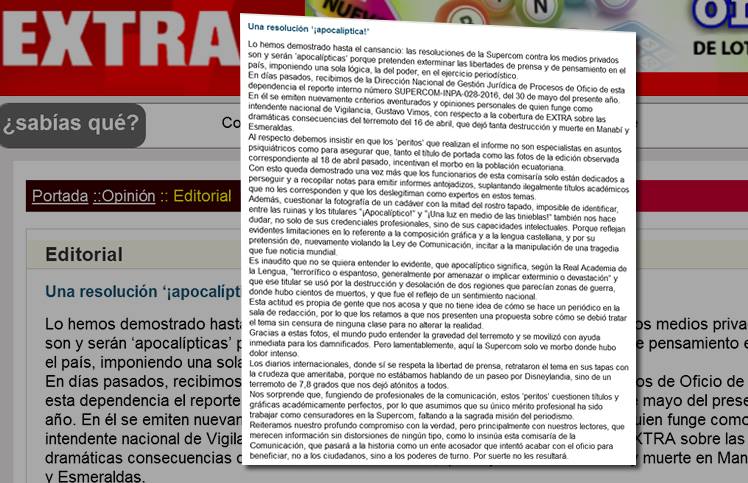
Diario Extra recibió una amonestación escrita por parte de la Superintendencia de la Información y Comunicación (Supercom), por considerar que el medio violó las normas deontológicas referentes al ejercicio profesional y el tratamiento morboso de la información (artículo 10, numeral 3, literal d) de la Ley Orgánica de Comunicación) por la publicación en portada de una nota periodística titulada: “Apocalíptico” y “Una luz en medio de las tinieblas”, publicada el 18 de abril del presente año, relacionado al terremoto. La sanción emitida de oficio este 21 de junio se dio porque, a criterio de la Supercom, “Diario Extra no evitó dar un tratamiento morboso a la información y violó públicamente los derechos humanos, razón por la que incumplió lo dispuesto en la Ley”.
Durante la audiencia ante la autoridad, el representante del medio manifestó su inconformidad por el proceso en contra del periódico y en gesto de rechazo, abandonó la audiencia. Actitud que fue cuestionada por el representante de la Supercom, quien la calificó de irrespetuosa y enfatizó que el diario tuvo las garantías para su legítima defensa.
En un editorial publicado por el medio antes de recibir la sanción, ya advirtió que la Supercom emitirá "criterios y opiniones personales", sin fundamentos médicos o psicológicos que determinen el tratamiento morboso de la información. En ese sentido, el medio insistió en que “es inaudito que no se quiera entender lo evidente, que apocalíptico significa, según la Real Academia de la Lengua, ‘terrorífico o espantoso, generalmente por amenazar o implicar exterminio o devastación’ y que ese titular se usó por la destrucción y desolación de dos regiones que parecían zonas de guerra, donde hubo cientos de muertos, y que fue el reflejo de un sentimiento nacional”.
Para diario Extra la actitud de la Supercom “es propia de gente que nos acosa y que no tiene idea de cómo se hace un periódico en la sala de redacción” por lo que se retó a la entidad reguladora a que les presenten una propuesta sobre cómo se debió tratar el tema sin censura de ninguna clase para no alterar la realidad.
Another newspaper is cautioned for failing to avoid morbid handling of news
Diario Extra received a written caution from the Superintendency of Information and Communication (Supercom), which ruled that the newspaper violated ethical rules concerning professional practice and the morbid handling of information (Article 10, paragraph 3, letter d) of the Organic Communications Law by publishing on its front page an article titled: "Apocalyptic" and "A light in the darkness", on 18 April this year, concerning the earthquake. The sanction was issued ex officio on 21 June because, in the opinion of Supercom, "Diario Extra did not avoid handling the information morbidly and publicly violated human rights, breaching thus the provisions of the Law".
During the hearing before the authority, the newspaper's representative challenged the proceedings against the media outlet and left the premises. His attitude was questioned by the representative of Supercom, who called it disrespectful and emphasized that the newspaper had guarantees for self-defense.
In an editorial published before receiving the caution, the newspaper had warned that Supercom would issue "personal criteria and opinions", without medical or psychological grounds to determine what is a morbid handling of information. The paper insisted that "it is outrageous that the obvious will not be understood, that apocalyptic means, according to the Royal Academy of Language, 'terrifying or horrific, usually because it threatens or implies destruction or devastation' and that the headline was used because of the destruction and desolation of two regions that looked like war zones, where there were hundreds of dead, and that it was the reflection of a national sentiment".
For Extra, Supercom's attitude "is typical of the people who harass us and have no idea how a newspaper is made in the newsroom". The newspaper challenged the regulatory entity to submit a proposal on how the issue should have been handled without censorship of any kind in order not to alter reality.