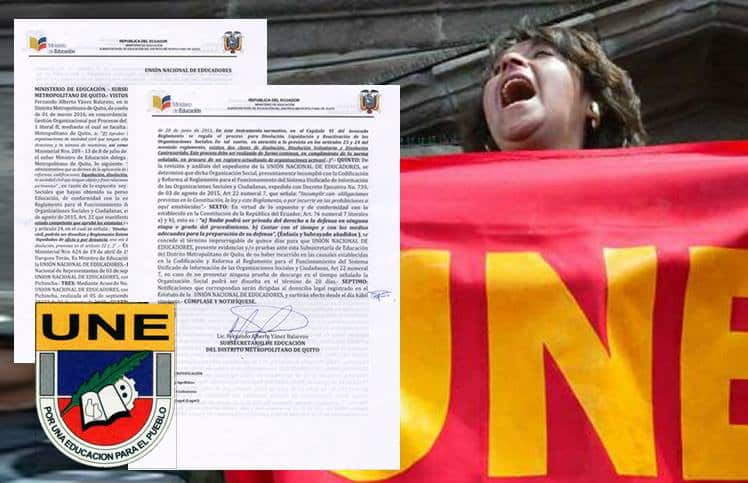
El Gobierno de Ecuador inició el proceso de disolución de la Unión Nacional de Educadores, UNE, el mayor sindicato de profesores del país, luego de que la presidenta de esta entidad Rosana Palacios, participó de las sesiones de la Organización Internacional del Trabajo, OIT y el Comité de Derechos Humanos de Naciones Unidas el pasado mes de junio. En aquellas instancias la UNE presentó información sobre violaciones a los derechos de los trabajadores de la educación en los últimos años.
La represalia al sindicato tomó forma este 21 de julio mediante un oficio firmado por Fernando Alberto Yánez Balarezo, subsecretario del Ministerio de Educación para el Distrito Metropolitano de Quito, en el cual se comunica a la UNE (sin especificar siquiera el nombre de sus autoridades) que se ha iniciado su proceso de disolución controvertida, de oficio o por denuncia, según el artículo 24 del Decreto 739 (Reglamento para el Funcionamiento del Sistema Unificado de Información de las Organizaciones Sociales) por haber incurrido en la causal de disolución 7, del artículo 22: “Incumplir las obligaciones previstas en la Constitución la ley y este Reglamento, o por incurrir en las prohibiciones aquí establecidas”.
En el documento, de dos carillas, no se detalla si el inicio del proceso es por denuncia o de oficio, pero se afirma que habría incumplido con sus obligaciones, sin especificarse cuál es el incumplimiento del que se le acusa y cuya consecuencia sería la disolución de la entidad que tiene personería jurídica desde el 19 de abril de 1950. El documento menciona una “revisión y análisis del expediente” cuyo contenido no ha sido notificado. Así, pese a desconocer con exactitud la acusación, se le otorga un término de 20 días para presentar pruebas de descargo, de lo contrario la organización verá su muerte jurídica.
Cerca de 50 organizaciones de la sociedad civil ecuatorianas presentaron 12 informes alternativos documentando violaciones a derechos fundamentales en Ecuador durante el período del Gobierno actual y 13 representantes de la sociedad civil lo defendieron durante el Examen sobre el cumplimiento del Pacto de Derechos Civiles y Políticos en la sede del Comité de DDHH de la ONU. La Presidenta de la ONU integraba la delegación. Altas autoridades, como el Presidente de la República y el Ministro de Relaciones Exteriores, se han referido despectivamente y han acusado a la sociedad civil de ser actores políticos y estar complotados para hacerle daño al Gobierno.
La UNE, en especial, ha sido acosada por políticas de represalia y fuertes ataques de las autoridades que no han ocultado el objetivo de debilitar e incluso disolver a la entidad, acusándola de oponerse a la políticas de Gobierno en el campo educativo.
Ecuadorian government begins dissolution of one of the largest trade unions after it appeared before the un's Human Rights instances
The Ecuadorian Government began the process of dissolution of the National Union of Educators, UNE, the largest teachers' union in the country, after its president Rosana Palacios participated in the sessions of the International Labour Organization, ILO and the UN's Committee on Human Rights in June. Before those instances the UNE presented information about the violation of the rights of education workers in recent years.
Retaliation against the union came on 21 July with a letter signed by Fernando Alberto Yánez Balarezo, undersecretary of the Ministry of Education for the Metropolitan District of Quito, in which he communicates the UNE (without even specifying the names of its authorities) that a process of contested dissolution, ex officio or upon complaint, has been initiated based on Article 24 of Decree 739 (Regulations for the Operation of the Unified Information System of Social Organizations) for incurring in grounds for dissolution 7, of Article 22: "Failure to comply with obligations mandated by the Constitution, the law and this Regulation, or for incurring in the prohibitions set forth herein".
The two-page document does not clarify whether the process was initiated based on a complaint or ex officio, but states that the UNE failed to comply with its obligations, without specifying the breach of which it is accused and which would result in the dissolution of the organization, which has legal status since 19 April 1950. The document mentions a "review and analysis of the file" whose content has not been notified. Thus, despite ignoring exactly what the charge is, the UNE is granted 20 days to present exculpatory evidence, otherwise the organization will face its legal death.
Approximately 50 organizations of the Ecuadorian civil society presented 12 alternative reports documenting violations of fundamental rights in Ecuador during the period of the present government and 13 representatives of the civil society defended it during the examination on compliance with the Covenant on Civil and Political Rights at the headquarters of the UN's Committee on Human Rights. The UN's President was part of the delegation. High-ranking authorities, such as the President of the Republic and the Minister for Foreign Affairs, have referred derisively to the civil society organizations and have accused them of being political actors who are conspiring to damage the government.
The UNE, in particular, has been beset by retaliatory policies and strong attacks by the authorities who have not hidden their intent to weaken and even break up this entity, accusing it of opposing government policies in the field of education.