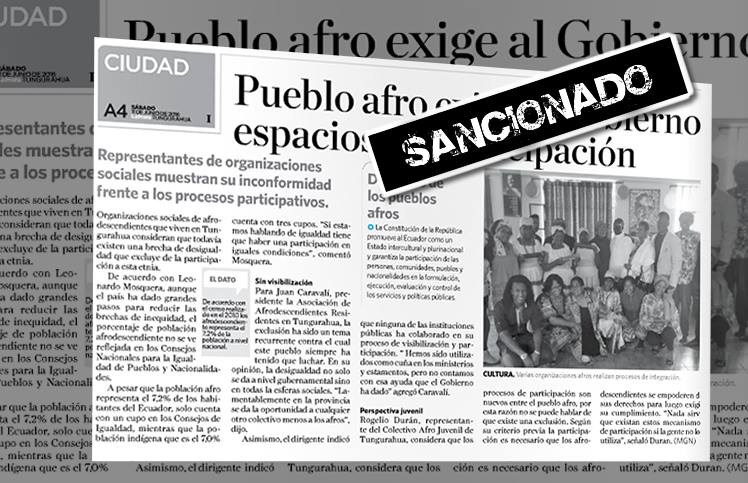
Diario La Hora de Tungurahua deberá disculparse públicamente con el pueblo afroecuatoriano y publicar nuevamente una rectificación. Así lo determinó este 26 de julio la Superintendencia de la Información y Comunicación (Supercom), luego de acoger una denuncia de Segundo Mosquera, afrodescendiente y parte de un grupo étnico del Ecuador, por incumplimiento con el derecho a la rectificación.
Mosquera presentó la queja por una nota publicada por el rotativo el 11 de junio titulada “Pueblo afro exige al Gobierno espacios de participación” cuyo titular no agradó al colectivo por mencionar la palabra “afro” y aseguró que el medio inobservó el artículo 23 de la Ley Orgánica de Comunicación (LOC), que da un plazo de 72 horas a los medios para cumplir con la rectificación solicitada.
En su resolución la Supercom concluyó que el medio no viabilizó el derecho de rectificación dentro del plazo que señala la ley, al publicar la carta íntegra remitida por Mosquera de forma “extemporánea”, el 18 de junio, cuando debió hacerlo un día antes.
Durante la audiencia, el representante del medio cuestionó que en ninguna parte del pedido de rectificación y la denuncia presentada se manifestó que el titular no agradó al colectivo lo cual recién lo conocieron el día de la diligencia. También aseguró que los denunciantes solicitaron la rectificación “en el mismo día y en el mismo espacio”, con lo cual el medio dijo haber cumplido con cabalidad el pedido.
Por su parte, el denunciante aseguró que el término “afro”, utilizado por el medio en el titular, se refiere a un tipo de peinado, según el diccionario”. También expresó que en la nota inicial hubo una descontextualización ya que luego de haber entregado un manifiesto de los Pueblos y Organizaciones de los Afrodescendientes, a diario La Hora, esperaban una noticia sobre el tema; sin embargo, la nota versó sobre otro asunto totalmente diferente.
Además, de las disculpas públicas en la versión impresa, La Hora deberá publicarlas en su página web durante un tiempo no menor a siete días consecutivos.
Newspaper is forced to "rectify" because headline with the word "Afro" is considered an "offense"
The newspaper La Hora from Tungurahua must publicly apologize to the Afro-Ecuadorian people and publish a rectification again. This was determined on 26 July by the Superintendency of Information and Communication (Supercom) after accepting a complaint from Segundo Mosquera, of African descent and part of an Ecuadorian ethnic group, for breach of the right to rectification.
Mosquera filed the complaint because of an article published by the newspaper on 11 June titled "Afro people demand from government opportunities for involvement", whose headline was not liked by the group because it mentioned the word "Afro", and claimed that the paper breached Article 23 of the Organic Communications law (LOC), which gives the media a period of 72 hours to comply with required rectifications.
In its resolution Supercom concluded that the newspaper did not comply with the right to rectification within the period prescribed by law, by publishing the full letter sent by Mosquera "extemporaneously", on 18 June, when it should have done it the day before.
During the hearing, the media outlet's representative stated that nowhere in the rectification request or the complaint filed was it stated that the headline was not liked by the group, something they were only informed of on that day. He also said that the complainants requested the rectification (should appear) "on the same day and in the same space", something with which the media outlet fully complied.
Meanwhile, the complainant stated that the term "Afro" used by the newspaper in the headline refers to a type of hairstyle, according to the dictionary. He also expressed that there was decontextualization in the original article because after having delivered a manifesto of the Peoples and Organizations of African Descent to the newspaper La Hora, they expected an article on the subject; but the article was about an entirely different matter.
As well as the public apology in the printed version, La Hora must publish it on its website for no less than seven consecutive days.